
This teacher pack has been created for teachers by Ricardo, on behalf of Fife Council for their Clean Air Day citizen science pack. The pack has been created with citizen science materials and exercises for pupils.
This pack will help pupils to understand the key issues around air pollution, what air pollution is, where it comes from, ways of tackling the issue and how they can influence their own air pollution impact.
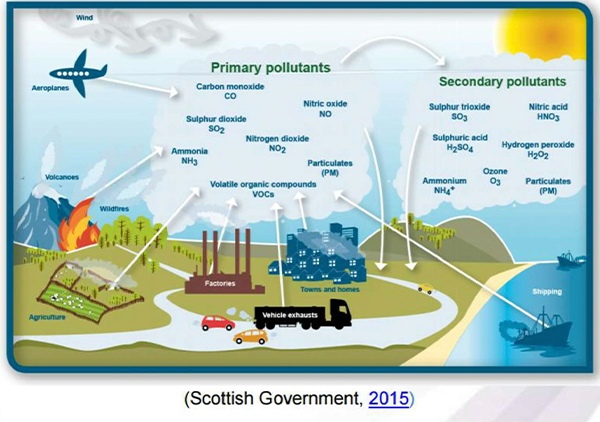
This includes a variety of gases and particulates (i.e. dust, soil, seal salt, etc) that can be detrimental to human health, ecosystems and agricultural crops (Natural Hazards Partnership, 2015). Air pollution comes from a variety of sources, which can be natural or from man-made activities (see Figure 1).
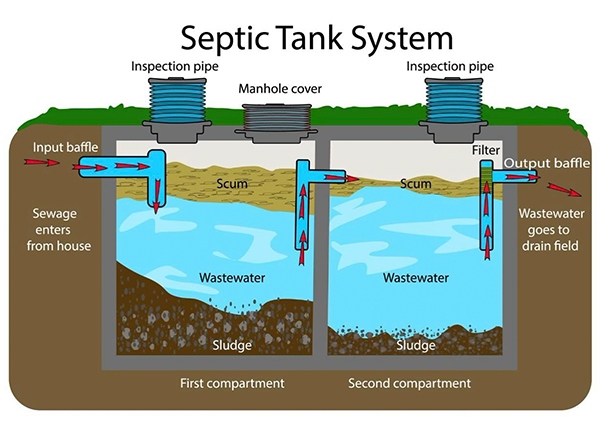
Septic Tank System Designs in Scotland (For illustrative purposes only – still to be fact checked)
In areas without mains sewerage (common in domestic rural Scotland), several types of on-site sewage treatment systems are used:
Septic Tank System Designs in Scotland (For illustrative purposes only – still to be fact checked)
In areas without mains sewerage (common in domestic rural Scotland), several types of on-site sewage treatment systems are used:
The five hectare site was formerly occupied by a sawmill and timber works for a hundred years from 1910. Since the buildings were demolished to slab level, natural revegetation has started to occur. It is located adjacent to a heavily modified surface watercourse and within a mixed residential and commercial/industrial setting. The site is located in an area of economic deprivation and is valued by the local public for informal recreational use.
The site was identified as long-term ‘vacant land’ and has been on the Fife Council Vacant and Derelict Land Register for over 15 years. It was being considered for improvement as part of a wider SEPA-led multi-partner initiative, The Leven Programme, to support regeneration of the river corridor. The local authority and SEPA identified the site as an area of potentially contaminated land requiring further investigation to enable it to be brought back into beneficial use to deliver economic, social and environmental outcomes for the local community. Development plans have yet to be finalised but current considerations include a range of end uses including provision of active travel opportunities enabling the local community to better engage with the redeveloped site and the adjacent river. Fife Council in 2019 secured approval to utilise monies from its allocation of the Scottish Government Vacant and Derelict Land Fund to unlock comprehensive desk-based and intrusive ground investigations on this complex site.
Promoting exemplary best practice and a robust cost effective and defensible solution
RSK Geosciences was initially commissioned by the local authority in 2020 to undertake a desk-based and exploratory intrusive investigation. Although the site was found to be less impacted by organic contaminants than anticipated, several contaminant linkages, including those related to human health and groundwater and surface water receptors, were identified to be potentially complete and require further investigation. A second commission in August 2021 – the subject of this entry – aimed to address data gaps and uncertainties identified within the CSM and further characterise the potential water environment linkages. Both phases of work were reported in accordance with the NQMS.

